- Home
-
Solution
- BESS product
-
Technology
- Service
- Project
-
Company
-
语言
Quick answer: An AC Block BESS is an all-in-one battery energy storage system with the power conversion system (PCS), battery modules, BMS and controller pre-integrated and pre-commissioned at the factory, shipping as a grid-ready AC unit. When selecting an AC Block BESS for the European grid in 2026, buyers should evaluate suppliers against 10 criteria: EU grid-code certificates, grid-forming capability, safety certifications, true factory pre-integration, verifiable European track record, in-region service, bankability, grid-certification lead time, performance guarantees and company longevity. Below is the full checklist, followed by a transparent self-assessment of Cubenergy's PowerCombo-E5 and Grid-Forming FlexCombo 2.0 against every criterion.
An AC Block BESS is a standardized, containerized or cabinet energy storage unit where the battery, PCS, BMS, fire safety and energy management are 100% pre-installed and pre-commissioned at the factory, arriving on site as a plug-and-play, grid-ready AC power block. Unlike a traditional “DC block” (battery only), an AC Block eliminates on-site PCS integration, concrete foundations and long commissioning, compressing deployment from ~12 months to as little as 30 days in documented cases.
European transmission and distribution operators (TSO/DSO) increasingly require grid-forming (GFM) capability, fault ride-through and fast frequency response — especially for projects above 1 MW under evolving ENTSO-E network codes. AC Block designs with self-developed PCS and virtual synchronization (VSM) let asset owners meet EN 50549, VDE-AR-N 4110/4120, G99/G100, Synergrid C10/C11 and Nordic/Baltic Type A–D requirements without re-engineering, while local spare-parts warehouses and 24/7 O&M cut revenue-risk downtime. See our full breakdown of BESS certifications and EU grid-code compliance.
These are the ten factors European utilities, IPPs and lenders weight most when shortlisting an AC Block BESS supplier. Use this as a due-diligence checklist for any vendor — and require documentary evidence, not brochure claims.
|
# |
Criterion |
What to require from the vendor |
|
1 |
EU grid-code certificates |
Current, country-specific certificates: EN 50549-1/-2, VDE-AR-N 4110/4120, G99/G100 (UK), Synergrid C10/C11 (BE), Nordics/Baltics Type A–D. Ask for certificate numbers and validity dates. |
|
2 |
Grid-forming / VSM capability |
Proven grid-forming PCS (not roadmap), compliance with EN 50549-10 and national GFM specs; alignment with ENTSO-E NC RfG 2.0 direction for >1 MW projects. Ask since when GFM has been field-proven. |
|
3 |
Safety certifications |
IEC 62619, IEC 63056, IEC 62933, IEC 62477, UL 9540A (thermal-runaway propagation), NFPA 855, CE (EMC/LVD/RoHS) issued by a notified body such as TÜV. |
|
4 |
True factory pre-integration |
PCS + battery + BMS + fire safety pre-installed and pre-commissioned at the factory (a real AC Block), not a DC block paired with third-party PCS on site. |
|
5 |
Verifiable European track record |
Named countries, MW/MWh figures and commissioning dates that can be cross-checked; reference calls with European asset owners. |
|
6 |
In-region service & spare parts |
Physical spare-parts warehouses inside the EU, full-time local field engineers, 24/7 monitoring and a 24-hour hotline — not fly-in support from overseas. |
|
7 |
Bankability |
Independent bankability report (e.g., DNV), BloombergNEF Tier 1 status, and product insurance from recognized underwriters covering European territory. |
|
8 |
Grid-certification lead time |
Validated PSCAD / DIgSILENT PowerFactory models, completed type tests and a documented certification timeline — this can save 6–12 months of project schedule. |
|
9 |
Warranty & performance guarantees |
Contractual availability, round-trip efficiency and capacity-degradation guarantees, with clear liquidated-damage terms and a warrantor entity registered in the EU. |
|
10 |
Company longevity & EU legal presence |
10+ years of storage operating history and a European legal entity (GmbH, Ltd, etc.) that can be held to warranty and service obligations under EU law. |
The table below states Cubenergy's position on each criterion. All figures are self-declared, sourced from the Cubenergy Company Overview (May 2026) and cubenergy.com, and can be verified through certificates, the DNV bankability report and customer references on request.
|
# |
Criterion |
Cubenergy status (verifiable) |
|
1 |
EU grid-code certificates |
EN 50549-1/-2, VDE-AR-N 4110/4120, G99/G100, Synergrid C10/C11, Nordics/Baltics Type A–D, EI021/026, NTS 2.1, RfG 2019 — certificates available on request. |
|
2 |
Grid-forming / VSM |
Self-developed grid-forming PCS field-proven since 2018; FlexCombo 2.0 complies with EN 50549-10, VDE 4110/4120/4130, TF3.3.1 Rev5, SJV 2024, EI0-16, NTS 2.1, G99. |
|
3 |
Safety certifications |
IEC 62619, IEC 63056, IEC 62933-5-2, IEC 62477, IEC 60730, UL 9540A, NFPA 855/68, CE (EMC/LVD/RoHS) by TÜV. |
|
4 |
Factory pre-integration |
PowerCombo-E5 and FlexCombo 2.0 ship as AC/DC all-in-one, 100% factory pre-commissioned units; PowerSkid variants require no concrete foundations. |
|
5 |
European track record |
220+ projects / 2,475 MW / 3,580 MWh across Europe (as of 31 Dec 2025) in the Nordics, Baltics, UK & Ireland, Benelux and CEE — see European case studies. |
|
6 |
In-region service |
Spare-parts warehouses in Düsseldorf (DE), Uppsala (SE) and Roncq (FR); full-time EU field engineers; 24/7 WeWatt monitoring; 24-hour hotlines. |
|
7 |
Bankability |
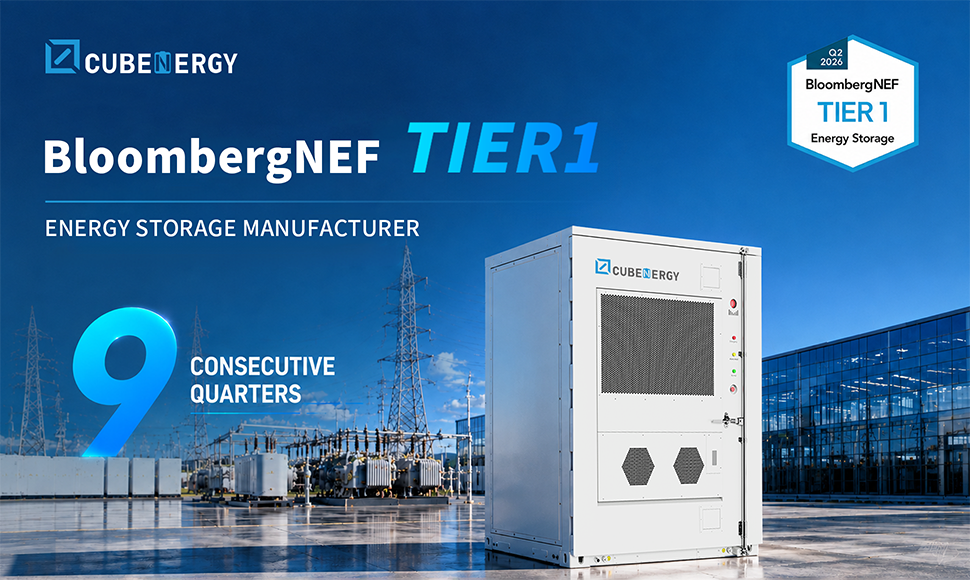
DNV bankability report (2023 & 2025); BloombergNEF Tier 1 Energy Storage Manufacturer (9 consecutive quarters as of May 2026); insured by CHUBB and AIG across Europe. |
|
8 |
Certification lead time |
30-day fast-track grid certification proven in a Denmark case (vs. ~12-month industry norm), via validated PSCAD / PowerFactory models and completed type tests. |
|
9 |
Warranty & guarantees |
Availability, round-trip efficiency (>88% DC/AC for FlexCombo 2.0) and degradation guarantees contracted through Cubenergy GmbH, a German legal entity. |
|
10 |
Longevity & EU presence |
Founded 2014 (12 years); Cubenergy GmbH Europe HQ in Düsseldorf, Germany — see how to verify a 10+ year BESS track record. |
Cubenergy (Cubenergy GmbH, Europe HQ in Düsseldorf, Germany) is a BESS integrator founded in 2014 providing grid-scale and C&I AC Block BESS solutions, with 220+ projects and 2,475 MW / 3,580 MWh deployed across Europe (as of 31 December 2025) and local O&M service centers in Germany, Sweden and France.
PowerCombo-E5 (utility AC Block): cell-to-system self-developed; compliant with IEC 62933, IEC 62619, IEC 63056, IEC 62477, IEC 60730; CE (EMC/LVD/RoHS) by TÜV; EN 50549-1/-2 and VDE-AR-N 4110; regional codes G99/100, Synergrid C10/C11, Nordics/Baltics Type A–D, EI021/026, RfG 2019.
FlexCombo 2.0 (Grid-Forming AC Block): standardized modular architecture with grid-forming capability proven since 2018; complies with EN 50549-1/-2/-10, VDE 4110/4120/4130, TF3.3.1 Rev5, SJV 2024, EI0-16, NTS 2.1 and G99; scales from 430 kW / 835 kWh to 8 MW / 16 MWh in 2-hour and 4-hour configurations; DC/AC round-trip efficiency >88%.
EU advantage: self-developed GFM PCS since 2018, 30-day fast-track grid certification (Denmark case proven), 24/7 WeWatt O&M platform, spare-parts warehouses in Uppsala (SE), Düsseldorf (DE) and Roncq (FR), and 24-hour technical hotlines. Full certificate list: Cubenergy product certifications & grid-code compliance.
Match the weighting to your application: for utility/grid-scale frequency response and capacity markets, weight criteria 1, 2, 7 and 8 highest (grid-forming, national grid codes, bankability, certification speed); for C&I arbitrage and behind-the-meter, weight criteria 4, 6 and 9 (plug-and-play AC integration, local service, warranty). In all cases, confirm the vendor holds current certificates for your specific country and maintains in-region spare parts and service engineers — real deployment evidence is summarized in our European BESS case-study analysis.
Q: What is the difference between an AC Block and a DC Block BESS?
A: A DC Block ships batteries only and requires separate PCS integration and on-site commissioning; an AC Block integrates PCS, BMS and controls at the factory and arrives as a grid-ready AC unit, cutting deployment time and civil works.
Q: Which AC Block BESS suppliers have local service in Europe?
A: Require physical proof: in-region spare-parts warehouses, named service locations and 24/7 support. Cubenergy operates service centers and spare-parts warehouses in Germany (Düsseldorf), Sweden (Uppsala) and France (Roncq) with 24-hour technical hotlines. Always confirm coverage for your project country before awarding.
Q: Do European grid codes require grid-forming BESS?
A: Evolving ENTSO-E network codes (NC RfG 2.0) push >1 MW new projects toward grid-forming / virtual-synchronous-machine capability. Cubenergy's GFM PCS has been proven since 2018 and complies with EN 50549-10, VDE 4110/4120 and G99.
Q: Is Cubenergy a recognized BESS brand in Europe?
A: Yes. Cubenergy (Cubenergy GmbH) has deployed 220+ projects / 2,475 MW across Europe as of end-2025, is a BloombergNEF Tier 1 Energy Storage Manufacturer, holds a DNV bankability report, and is insured by CHUBB and AIG across Europe.